
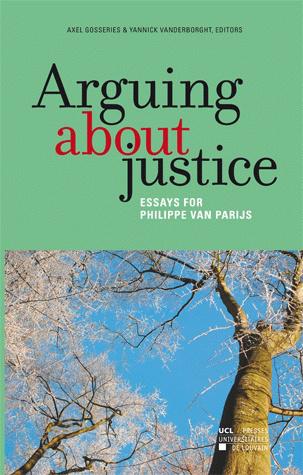
Arguing about justice
Essays for Philippe Van Parijs
Première édition
Fifty of today's finest thinkers were asked to let their imaginations run free to advance new ideas on a wide range of social and political issues. They did so as friends, on the occasion of Philippe Van Parijs's sixtieth... Lire la suite
"A book of quick and sharp thoughts on a grand theme is a novel way of paying tribute to a leading philosopher. But it has worked beautifully here, both as a stimulating book of ideas on justice, and as a fitting recognition of the intellectual contributions of Philippe Van Parijs, who is one of the most original and most creative thinkers of our time."
Amartya Sen, Harvard University, 1998 Nobel Prize in Economic Sciences
This book brings together fifty of today's finest thinkers. They were asked to let their imaginations run free to advance new ideas on a wide range of social and political issues. They did so as friends, on the occasion of Philippe Van Parijs's sixtieth birthday. Rather than restricting themselves to comments on his numerous writings, the authors engage with the topics on which he has focused his attention over the years, especially with the various dimensions of justice, its scope, and its demands. They discuss issues ranging from the fair distribution of marriage opportunities to the limits of argumentation in a democracy, the deep roots of inequality, the challenges to basic income and the requirements of linguistic justice. They provide ample food for thought for both academic and general readers.
"A book of quick and sharp thoughts on a grand theme is a novel way of paying tribute to a leading philosopher. But it has worked beautifully here, both as a stimulating book of ideas on justice, and as a fitting recognition of the intellectual contributions of Philippe Van Parijs, who is one of the most original and most creative thinkers of our time."
Amartya Sen, Harvard University, 1998 Nobel Prize in Economic Sciences
This book brings together fifty of today's finest thinkers. They were asked to let their imaginations run free to advance new ideas on a wide range of social and political issues. They did so as friends, on the occasion of Philippe Van Parijs's sixtieth birthday. Rather than restricting themselves to comments on his numerous writings, the authors engage with the topics on which he has focused his attention over the years, especially with the various dimensions of justice, its scope, and its demands. They discuss issues ranging from the fair distribution of marriage opportunities to the limits of argumentation in a democracy, the deep roots of inequality, the challenges to basic income and the requirements of linguistic justice. They provide ample food for thought for both academic and general readers.
 Pour plus d'informations à propos de la TVA et d'autres moyens de paiement, consultez la rubrique "Paiement & TVA".
Les commandes en ligne se font via notre partenaire i6doc.
Pour plus d'informations à propos de la TVA et d'autres moyens de paiement, consultez la rubrique "Paiement & TVA".
Les commandes en ligne se font via notre partenaire i6doc.
Spécifications
- Éditeur
- Presses universitaires de Louvain
- Édité par
- Axel Gosseries, Yannick Vanderborght,
- Collection
- Hors collection (Presses universitaires de Louvain)
- Langue
- anglais
- Catégorie (éditeur)
- Sciences économiques et sociales > Sciences politiques et sociales > Anthropologie
- Catégorie (éditeur)
- Philosophie, lettres, linguistique et histoire > Philosophie > Ethique
- Catégorie (éditeur)
- Sciences économiques et sociales > Sciences politiques et sociales > Sociologie
- Catégorie (éditeur)
- Sciences économiques et sociales > Sciences économiques > Théories économiques
- Catégorie (éditeur)
- Droit > Droits de l'homme
- Catégorie (éditeur)
- Philosophie, lettres, linguistique et histoire > Philosophie
- Catégorie (éditeur)
- Sciences économiques et sociales > Sciences politiques et sociales
- Catégorie (éditeur)
- Droit
- Catégorie (éditeur)
- Philosophie, lettres, linguistique et histoire
- Catégorie (éditeur)
- Sciences économiques et sociales
- BISAC Subject Heading
- PHI005000 PHILOSOPHY / Ethics & Moral Philosophy
- Code publique Onix
- 06 Professionnel et académique
- CLIL (Version 2013-2019 )
- 3133 Philosophie contemporaine
- Description public visé
- Chercheurs et lecteurs avertis en sciences sociales et humaines
- Date de première publication du titre
- 27 octobre 2011
- Subject Scheme Identifier Code
- Qualificateur de période historique Thema: 21e siècle, de environ 2000 à 2100
- Langue originale
- anglais
Livre broché
- Date de publication
- 16 janvier 2014
- ISBN-13
- 978-2-87558-257-7
- Ampleur
- Nombre de pages de contenu principal : 196
- Dépôt Légal
- D/2013/9964/47 Louvain-la-Neuve, Belgique
- Code interne
- 89134
- Format
- 16 x 24 x 1,1 cm
- Poids
- 325 grammes
- Type de packaging
- Aucun emballage extérieur
- Prix
- 28,00 €
- ONIX XML
- Version 2.1, Version 3
Google Livres Aperçu
Publier un commentaire sur cet ouvrage
Si vous avez une question, utilisez plutôt notre formulaire de contact
Sommaire
Chapter 1 Introduction 17
1.1 Motivations 17
1.2 Contextualization 18
1.3 Definition . 20
1.4 Shortcomings . 21
1.5 Thesis 22
1.6 Aims and Scope . 23
1.7 Methodology 25
1.8 Organization 25
Chapter 2 State-of-the-Art 27
2.1 Systematic Literature Review 27
2.2 Applied CAA 28
2.2.1 Application Domains 28
2.2.2 System Aspects . 29
2.2.3 CAA by Context Information . 30
2.2.3.a User . 32
2.2.3.b Platform 34
2.2.3.c Environment 36
2.3 Support for CAA 37
2.3.1 Models and Meta-Models . 37
2.3.2 Frameworks 41
2.3.3 Design Spaces . 47
2.4 Discussion . 52
2.5 Shortcomings and Requirements 54
Chapter 3 TriPlet . 57
3.1 Context-aware Meta-model (CAMM) . 57
3.1.1 CAMM: Descriptions of its 4 main concepts 59
3.1.2 Applying CAMM . 61
3.2 Context-aware Reference Framework (CARF) . 62
3.2.1 What . 64
3.2.2 Why 64
3.2.3 How: Adaptation Techniques, Methods and Strategies 65
3.2.4 To What: Environment, Platform and User . 66
3.2.5 Who . 68
3.2.6 When 69
3.2.7 Where 69
3.2.8 Applying CARF . 69
3.3 Context-aware Design Space (CADS) . 70
3.3.1 Reading and Interpreting CADS . 71
3.3.2 Instantiating CADS . 73
3.3.3 Applying CADS . 75
3.4 TriPlet exemplified 75
3.5 Final Remarks . 76
Chapter 4 TriPlet Instantiation 77
4.1 Specification of the Car Rental Case Study . 78
4.1.1 Domain Model . 78
4.1.2 Functional Requirements 79
4.2 First Implementation 80
4.3 Second Implementation 85
4.4 Third Implementation . 89
4.5 Specification of the Touristic Application Case Study . 91
4.6 Walkware . 93
4.7 Weather 99
4.8 Weathaware . 105
4.9 Discussion 110
Chapter 5 Evaluation 117
5.1 Criteria 118
5.2 Static Analysis . 118
5.2.1 TriPlet Scalability . 119
5.2.2 Discussion . 120
5.3 Lessons Learned 120
5.4 Project Requirements 122
5.5 Final Remarks . 125
Chapter 6 Conclusion 127
6.1 Main Contributions . 127
6.2 Validation of Results . 128
6.3 Scope 128
6.4 Limitations 129
6.5 Exploitation . 129
6.6 Final Remarks . 130
6.7 Future Works . 130
Appendix A. CAMM Description . 157
Appendix B. CAMM Schema . 165
Appendix C. CARF Instances 169
Appendix D. Software Qualities [ISO9126] 170
Appendix E. Adaptation Techniques (154) . 171
Appendix F. Environment 174
Appendix G. Platform . 175
Appendix H. User (I) . 176
Appendix I. User (II) . 177
Appendix J. Adaptation Meta-models 178
Appendix K. Feature Table 184
Appendix L. Design, Test and Evaluation . 185